🔬 Convergent Research at PreMiEr
What is Convergent Research?
At PreMiEr, we bring together experts in microbiology, engineering, data science, and social science to solve one challenge: how to make the buildings where we live, work, and heal healthier and safer.
Scientists call this convergent research because it unites knowledge from different fields to solve problems that are too complex for one discipline alone.
Our Vision
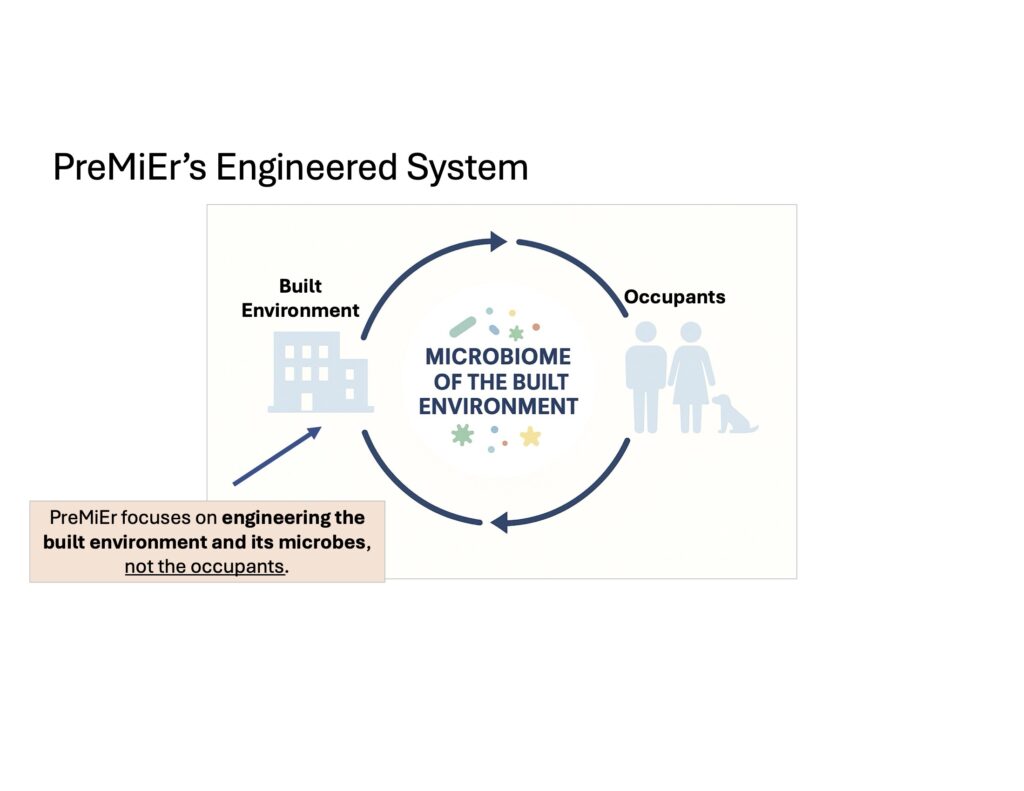
We believe buildings should work with microbes, not just against them.
Most cleaning strategies aim to wipe out all microbes. That sounds reassuring, but it also removes beneficial microbes that help protect us. This “kill everything” approach often backfires. It leaves behind what scientists call microbial deserts, places where harmful microbes can grow back quickly and sometimes become harder to fight.
PreMiEr’s vision is to design and operate buildings so that beneficial microbes thrive and harmful ones are blocked.
How We Do It: The Feedback Loop
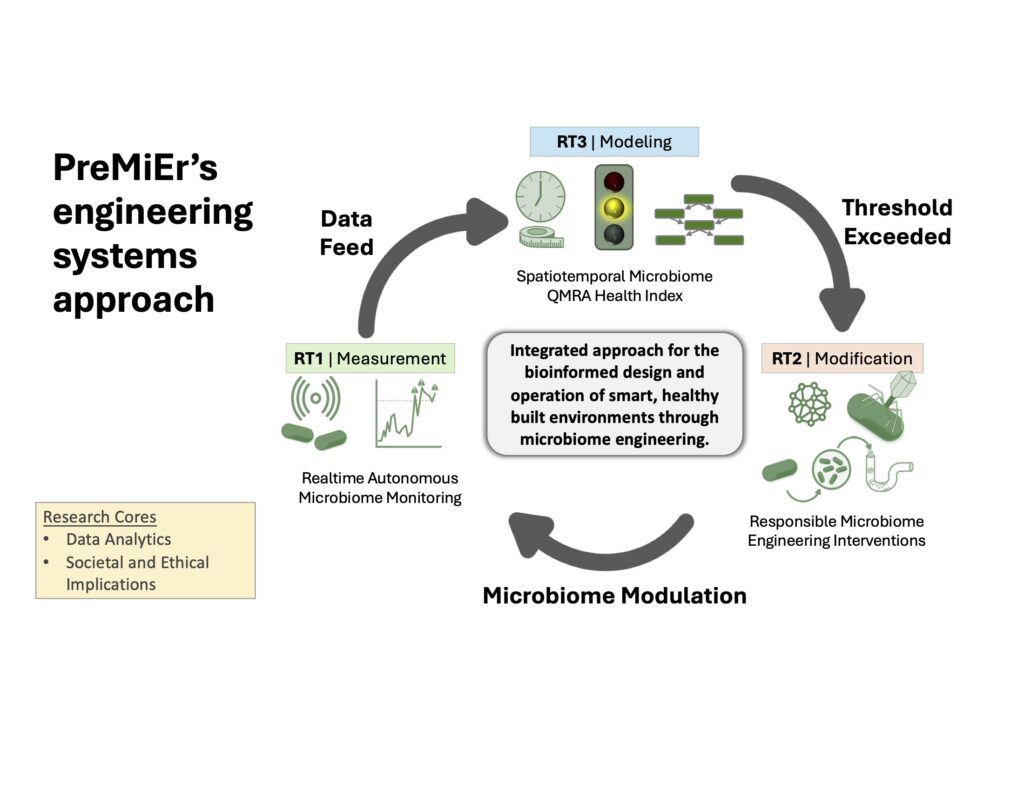
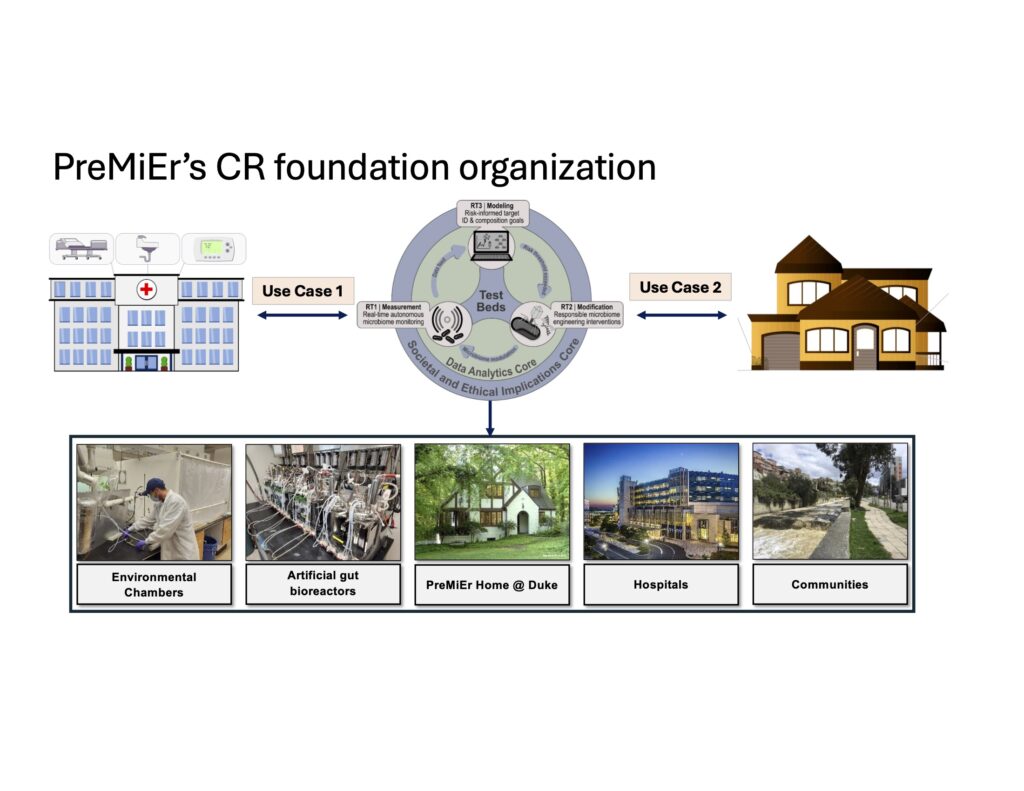
PreMiEr manages building microbiomes through a three-part cycle: Measure, Modify, Model. It works a lot like how doctors care for patients.
Measure: Just as a doctor takes your vital signs, we take the vital signs of a building. Sensors and sampling tools detect which microbes are present on surfaces, in the air, and in the plumbing. We also measure conditions such as airflow, humidity, and cleaning practices. This tells us how healthy or at risk the building is.
Modify: If the “vital signs” show a problem, action is needed. Doctors prescribe treatments, and we do the same for buildings. We apply targeted strategies to restore balance, such as adjusting ventilation, changing cleaning approaches, or introducing beneficial microbes that crowd out harmful ones.
Model: After treatment, doctors track progress and make predictions about recovery. We model building health in the same way. By combining thousands of data points, our models forecast risks, identify when interventions are working, and guide the next steps for healthier environments.
Together, this cycle of measure, modify, and model helps us move from reacting to problems after they occur to preventing them before they spread. It allows us to treat buildings as living systems that can be monitored, adjusted, and guided toward health.
Our Research Focus Areas
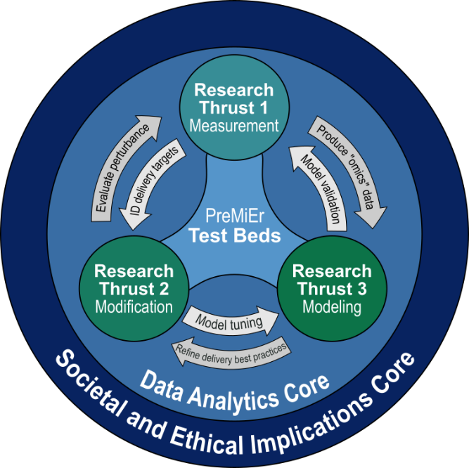
- RT1-Measurement. Developing advanced tools and sensors to detect microbes in real time.
- RT2-Modification. Designing strategies to shift indoor microbial communities toward health.
- RT3-Modeling. Using data and predictive models to understand risks and guide decisions.
Where This Matters Most: Use Cases
- Hospitals: Our goal is to reduce hospital acquired infections by monitoring microbes in real time, predicting risks, and designing targeted interventions. Hospital acquired infections affect one in thirty-one patients and cost the U.S. tens of billions of dollars each year.
- Homes and communities: Mold and poor air quality increase the risk of asthma, allergies, and other health problems. We are developing ways to prevent mold growth and design healthier living spaces that support well-being.
Our “testbeds” serve as real world labs. They include controlled chambers, real homes, and hospital spaces. Testbeds let us test solutions in realistic conditions, improve them, and prepare them for broad use.
Use Case 1: Hospitals
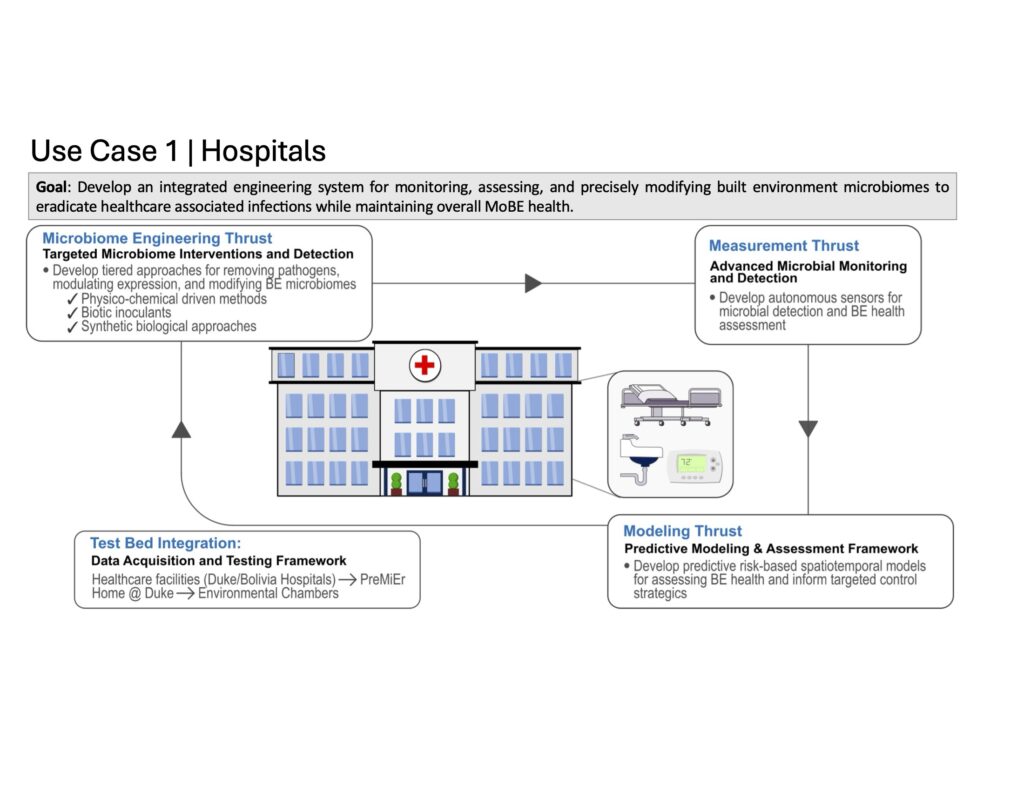
Hospitals save lives, but they can also expose patients to dangerous microbes. Hospital acquired infections affect about one in thirty one patients and cost the U.S. healthcare system between 28 and 45 billion dollars every year.
Some of the toughest microbes to fight are the ESKAPEE pathogens. These are bacteria that resist many antibiotics and can survive in hospital environments. They include Staphylococcus aureus, Klebsiella pneumoniae, and Pseudomonas aeruginosa.
PreMiEr’s hospital research combines three areas of strength.
- Measurement: We are building autonomous sensors that can continuously monitor hospital surfaces and air for microbial imbalances.
- Modification: We use that data to design targeted strategies, such as probiotics, cleaning methods, or synthetic biology approaches, that restore healthy balance.
- Modeling: We create predictive models that integrate hospital data, forecast risks, and guide precise interventions.
Together, these pieces form a system that can detect problems early, respond quickly, and prevent dangerous infections before they spread.
Use Case 2: Homes and Communities
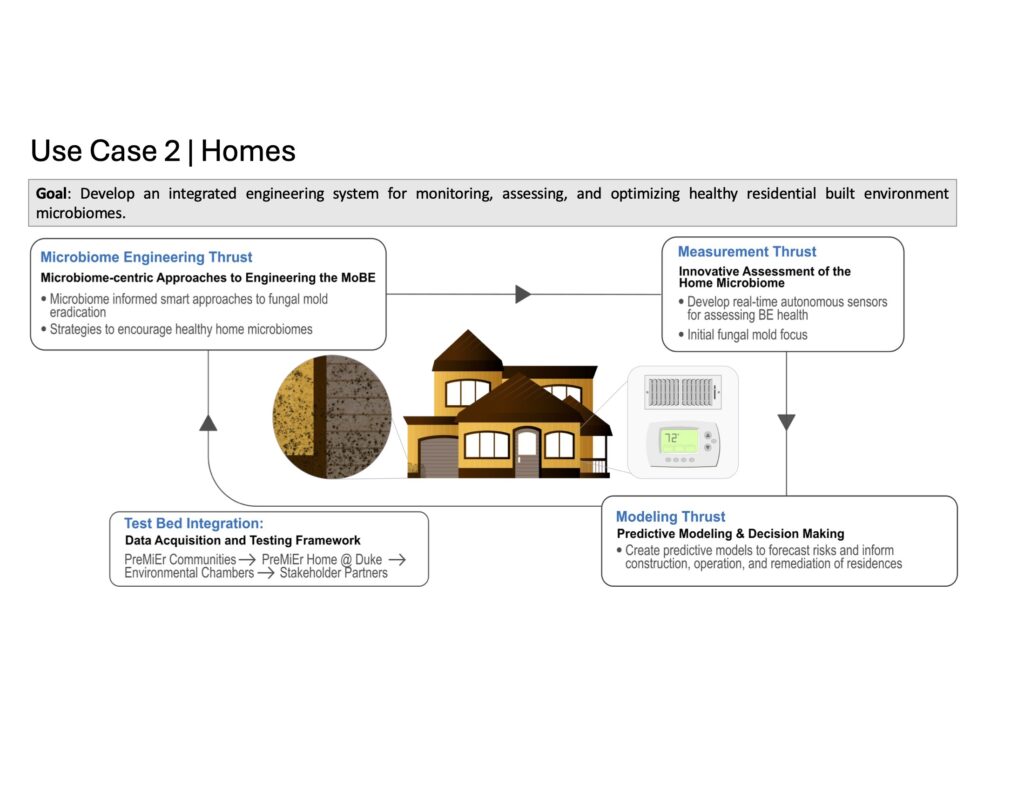
Everyone deserves a healthy home. Yet mold and poor indoor air quality are common and linked to asthma, allergies, and billions of dollars in health costs each year.
PreMiEr’s work in homes and communities focuses on prevention and resilience.
- Measurement: We are developing real time sensors that detect mold, humidity, temperature, and other indicators of indoor health.
- Modification: We design strategies to stop mold from taking hold and to encourage healthier home microbiomes overall.
- Modeling: We use predictive models that combine environmental and microbial data to forecast risks and inform healthier building design.
Our testbeds include the PreMiEr Home at Duke and a range of community spaces. These real world labs help us understand how solutions work in different settings and how to scale them for many types of homes.
Funded Projects
Each year PreMiEr selects a portfolio of projects that advance our mission. Projects are chosen through a transparent process that includes landscape analysis, advisory board feedback, and calls for proposals from our researchers.
This process ensures that projects:
- Reflect the latest scientific knowledge.
- Address real world needs in hospitals and homes.
- Advance our long term strategic vision.
- Meet NSF requirements for rigor and accountability.
Projects span across our three main research areas. Some focus on developing new sensors for real time microbial monitoring. Others test new ways to restore balance with biotic inoculants or synthetic biology. Still others build data models that predict risks and guide healthier building design.
All funded projects are interdisciplinary and collaborative. They are tracked through milestones and reviewed by scientific and industry advisors. This cycle of innovation, testing, and feedback ensures that our work remains cutting edge and aligned with public health needs.
Explore our Projects
Projects by Thrust
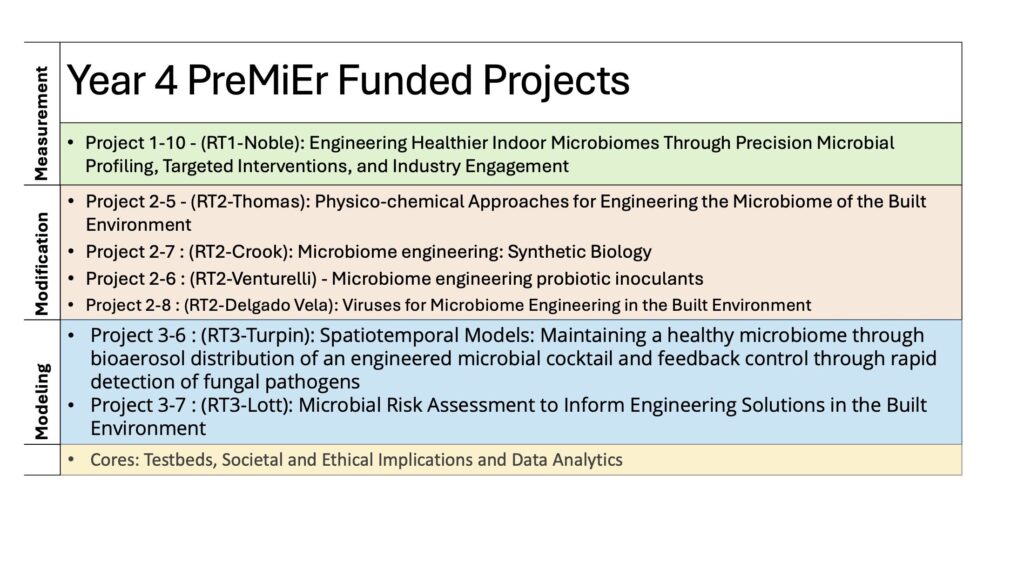
| (RT1-Noble): Engineering Healthier Indoor Microbiomes Through Precision Microbial Profiling, Targeted Interventions, and Industry Engagement |
| (RT2-Thomas): Physico-chemical Approaches for Engineering the Microbiome of the Built Environment |
| (RT2-Venturelli): Microbiome Engineering: Probiotic Treatments |
| (RT2-Crook): Microbiome engineering: Synthetic Biology |
| (RT2-Delgado Vela): Viruses for Microbiome Engineering in the Built Environment |
| (RT3-Turpin): Spatiotemporal Models: Maintaining a healthy microbiome through bioaerosol distribution of an engineered microbial cocktail and feedback control through rapid detection of fungal pathogens |
| (RT3-Lott): Microbial Risk Assessment to Inform Engineering Solutions in the Built Environment |
Projects by Use Case
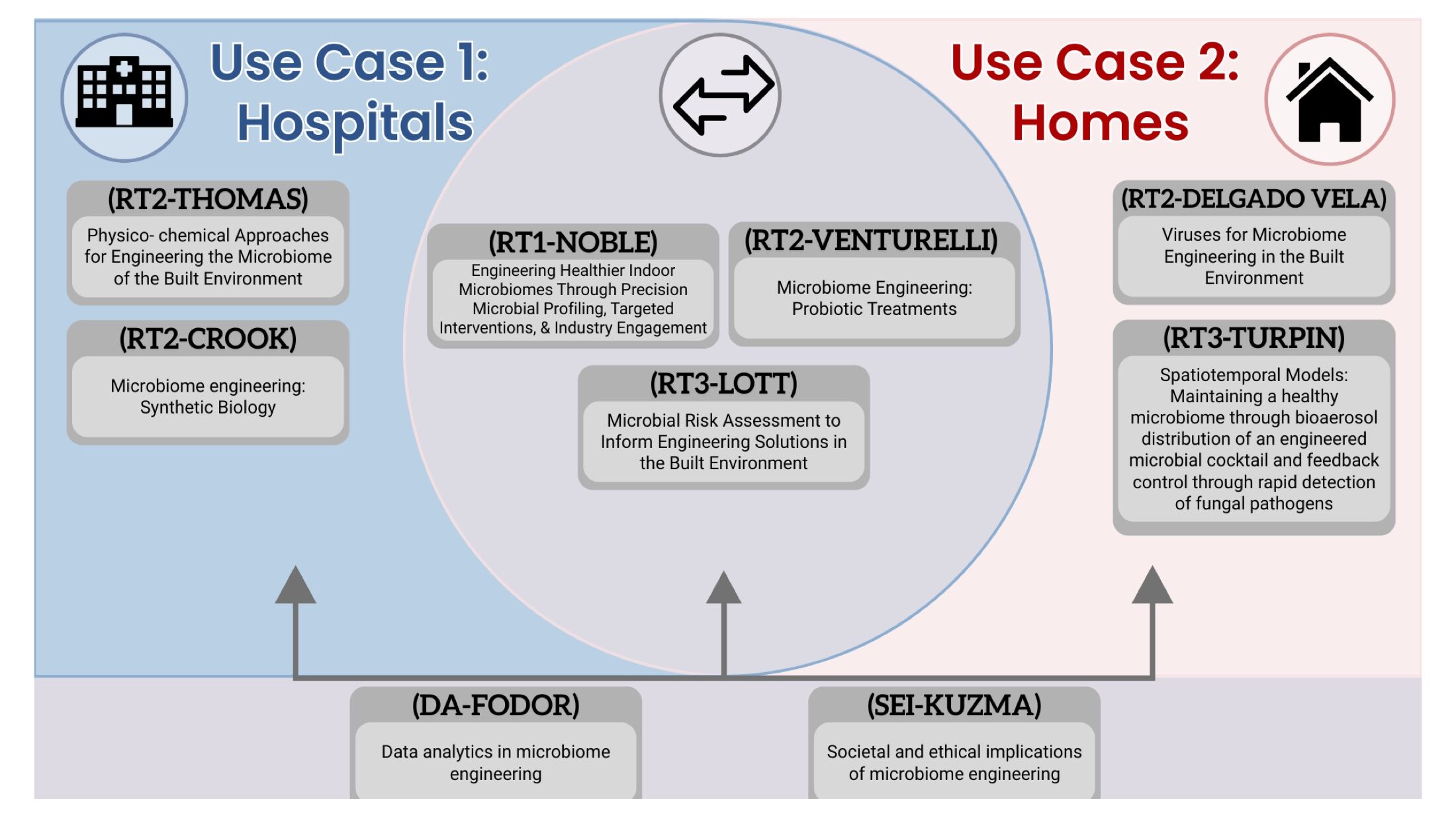
Use Case 1
| (RT2-Thomas): Physico-chemical Approaches for Engineering the Microbiome of the Built Environment |
| (RT2-Crook): Microbiome engineering: Synthetic Biology |
Use Case 1 & 2
| (RT1-Noble): Engineering Healthier Indoor Microbiomes Through Precision Microbial Profiling, Targeted Interventions, and Industry Engagement |
| (RT2-Venturelli): Microbiome Engineering: Probiotic Treatments |
| (RT3-Lott): Microbial Risk Assessment to Inform Engineering Solutions in the Built Environment |
Use Case 2
| (RT2-Delgado Vela): Viruses for Microbiome Engineering in the Built Environment |
| (RT3-Turpin): Spatiotemporal Models: Maintaining a healthy microbiome through bioaerosol distribution of an engineered microbial cocktail and feedback control through rapid detection of fungal pathogens |
Explore our Cores
All Convergent Research projects are supported by two core teams.
- Societal and Ethical Implications: Making sure solutions are safe, fair, and trusted by the public.
- Data Analytics: Ensuring that data is reliable, connected, and actionable across all projects.