News
All News

Flesh-Eating Bacteria Cases Surge Along North Carolina’s Coast
North Carolina reported 59 Vibrio infections and one death through July 2025, as cases of flesh-eating bacteria surge along the Southeast coast fueled by warming coastal waters.

MIT Physicists Confirm Light’s Dual Nature in Landmark Quantum Experiment
MIT physicists have performed a stripped-down, atomic-scale version of the famous double-slit experiment, confirming with new precision that light's two identities as wave and particle can never be observed at the same time.

NC State Research: Not All Probiotics Help Gut Recovery After Antibiotics
NC State researchers find that not all probiotics are created equal, with some strains helping gut microbiome recovery after antibiotic treatment and others actually making it worse, depending on the specific strain used.
Google Forms Consumer Health Advisory Panel, Including Duke’s Gary Bennett
Google has appointed a 12-member Consumer Health Advisory Panel to guide the responsible development of AI-powered health technologies, with Duke University's Gary Bennett among the distinguished experts named to the group.
NC A&T Brings Free Biotechnology Resources to Triad Teachers
North Carolina A&T State University is offering free biotechnology training and classroom lab kits to Triad teachers through the Amgen Biotech Experience program, helping K-12 students get hands-on exposure to science and STEM careers.
Algae Blooms in Lake Norman Threaten Local Ecosystems
PreMiEr researcher Dr. Sandra Clinton of UNC Charlotte speaks with WFAE about the surge of harmful algal blooms at Lake Norman, driven by warm temperatures and fertilizer runoff, and the risks cyanobacteria pose to people, pets, and local ecosystems.
New PreMiEr Publication: Universal Scaling Laws Discovered Across Thousands of Bacterial Plasmids
A new PreMiEr study published in Nature Communications uncovers three universal scaling laws governing plasmid organization across thousands of bacterial and archaeal genomes, revealing fundamental constraints on how plasmids evolve.
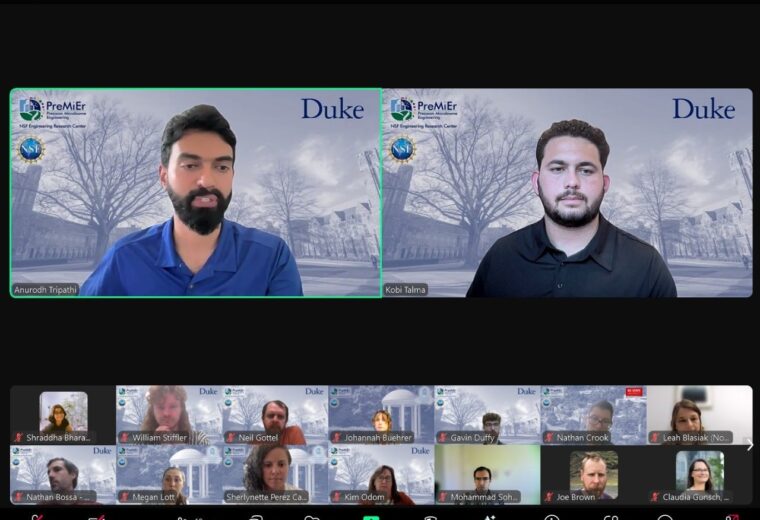
PreMiEr’s Industry Advisory Board Meeting